Biography
Alexander, Frank Edward b. February 8, 1911, Grand Island, Sandhills Region, Nebraska; African American; Father Mark Alexander, mother Ella Rae Speaks (or Baker) (1866-?); 2 years High School education; Single; Laborer and Prizefighter; CP 1931 and YCL 1933; Received Passport# 28793, San Francisco series, on May 28, 1937 which listed his address as 1705 E 15th Street, and 535 ½ E 16th Street, both Los Angeles, California; Sailed June 12, 1937 aboard the Georgic; Arrived in Spain via Setcases on June 30, 1937; Entered the IB on July 3, 1937 for training; Served with the XV BDE, Washington BN from September 7, 1937 until sent to hospital on August 24, 1938; Left the hospital on September 1, 1938, intent on crossing into France but was arrested; Lincoln-Washington BN; Mackenzie-Papineau BN, MG Co. (at some point may have served in the 59th BN, Co. 3); Served at Fuentes de Ebro and the Retreats; left behind in Ripoll; Sent to Castelldefels on January 13, 1939; After leaving Spain he was detained in a French Concentration camp; Returned to the US on March 3, 1939 aboard the Manhattan; By 1940 he was married to Lillian Perlowe (1918-1974); Fellow veteran Aaron Johnson lived with Alexander and his Lillian until shortly before his death; WWII US Army, enlisted June 4, 1942; Assigned to the 93rd Division, 318th Engineer Combat Battalion, Co. B, Rank First Sergeant, PTO; d. April 13(12), 1996, Seattle, Washington.Siblings: brothers LeRoy Ray Alexander (1907-1991), Herschell (Hersel) William Alexander (1914-1975), Mark H. Alexander (1901-1975), sisters Rena F. Alexandra Alexander (1910-2007), Opal Alexander (1900-?).
Source: Scope of Soviet Activity; Cadre; Figueres List; Americans; Inventory North Americans; Mac-Paps; RGASPI Fond 545, Opis 6, Delo 541; Opis 6, Delo 856, ll. 14-16; African Americans; L-W Tree Ancestry. Code A
Biography Frank Edward Alexander was born on the Omaha Sioux Indian reservation in Nebraska on February 8, 1911. Alexander's mother was white and his father, a cowboy who had ridden for the Pony Express, was black. Although not Native Americans, Alexander lived on a reservation for several years because Native Americans were more accepting of his parents' mixed race marriage. After the death of his mother, Alexander stayed briefly with his younger brother, Hursel, who had become involved in the IWW and was living in the home of the famed Communist leader, Mother Bloor. He then moved to Los Angeles where he found lodging in a Young Communist League (YCL) flophouse in Los Angeles. Among his roommates were Aaron Johnson, Otto Reeves, Norman Lisberg, Virgil Rhetta, and Alpheus Prowell, all black Communists who later served in the Spanish Civil War. Alexander supported himself by selling chickens from a truck and working at various construction jobs. He became a Communist in 1931 and through the party met some Hollywood personalities, including John Steinbeck and Joan Crawford, who were involved in its activities. Alexander sailed for France aboard the Georgic on June 12, 1937. In Spain he was assigned to the Washington Battalion, but soon contracted pneumonia and was hospitalized. After his recovery he was reassigned to the Mackenzie-Papineau Battalion and appointed squad leader of a machine-gun company. Alexander was wounded twice during the fighting at Fuentes de Ebro. Alexander "deserted" from the hospital where he was recuperating to rejoin the XVth Brigade. During the fighting at Teruel, Alexander and his squad were ordered on a reconnaissance patrol near the enemy's lines but were caught in the open and cut down by long-range machine gun fire. Alexander was the only man to survive the sprint back to friendly lines. During the retreats that followed the Nationalist's rapid advance in March and April 1938, Alexander found himself behind enemy lines. After several harrowing days, including a night perched in a tree directly above an Italian encampment, Alexander made it back across the Ebro into Republican territory. Alexander was with the Mac-Paps when they crossed the Ebro during the Republic's last offensive in July of 1938. However, he was wounded shortly after the offensive began and spent the remainder of his time in a Spanish hospital. Due to the severity of his wound, Alexander was left behind when the other Americans were withdrawn. He finally crossed the Pyrenees, together with thousands of Spanish refugees and, together with them, was imprisoned by French authorities in a hastily constructed concentration camp around Perpignan. He spent several weeks there until a U.S. embassy official arranged his passage to the United States. He finally returned to the US on March 3, 1939 aboard the Manhattan. Alexander returned to Los Angeles where he found employment as a welder. Later that year, he met and married Lillian Perlowe. Their marriage certificate falsely described her as a Negro because interracial marriages were illegal in California. During World War II, Alexander enlisted in the Army and was assigned to Company B of the 318th Engineer Combat Battalion, an African-American outfit. He was promoted to First Sergeant and served in the Pacific during the Guadalcanal campaign. Alexander returned home in December 1945. After the war Alexander was a full-time Communist party functionary from 1948 to 1955. He chaired the Negro Commission of the Los Angeles Communist party and was a member of the California state committee. During the McCarthy period, Alexander endured constant surveillance and harassment. He was indicted as one of the Los Angeles Twenty-One, a group of Communist party members charged with conspiracy. The charges against Alexander were subsequently dropped but not before he had served a short jail term. Both Alexander and his wife resigned from the CPUSA following the Soviet invasion of Hungary in 1956. In the years that followed, he built a successful business as a contractor and hardware store owner. Alexander died on April 15, 1996 in Seattle, Washington. ~ Chris Brooks
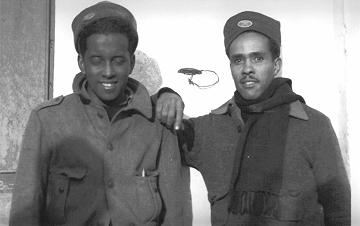
Photograph: Otto Reeves and Frank Alexander of Mackenzie-Papineau Battalion, December 1937. The 15th International Brigade Photographic Unit Photograph Collection; ALBA Photo 11; ALBA Photo number 11-0995. Tamiment Library/Robert F. Wagner Labor Archives. Elmer Holmes Bobst Library, 70 Washington Square South, New York, NY 10012, New York University Libraries.